
National Living Wage increase: What does this mean for operators?

Priced out: The struggles facing operators in wake of increasing NLW

This year, there’s been a 11.5% surge in the annual minimum wage, once the increases for lower age workers are added into the mix. It’s left the industry shocked, and understandably raising ever more concerns about the hefty financial load weighing on our sector with the associated risk for the industry. 

For those of us, myself included, still grappling with the aftermath of our coronavirus loans, life just got tougher. As I’ve been sharing with many, we took out loans of £150k per pub during the pandemic. Initially, a base +5% interest rate seemed manageable with such low base rates, but now our rate has doubled to 10% and the burden has significantly intensified. We’re still in the process of paying off the loan and now each pub requires an extra £40k before we even begin to make headway. 

Even with payroll at 30% of sales for a business generating £1.5 million in turnover, the minimum wage hike is tacking on an additional £50k to our expenses, and our profit, if we don’t act. What used to be a substantial but manageable variable cost for labour is increasingly becoming the toughest and most challenging line on the P&L. 

My job as a restaurant owner and software supplier is to figure out the best way to manage my business going forward. Really, there are only two options: put up prices or drive further efficiencies. The reality is we will have to do both. As we see month-on-month food prices dropping, and the price of electricity seemingly stabilising, we might hope that we can slightly raise prices and convert most of that increase to our bottom line. The question is how we much we dare increase prices when already the customer has a degree of cheque shock! 

The remainder of the cost savings will have to come through further efficiencies. For us, the biggest debate will be how we can drive food efficiencies. We aren’t big enough to have a central kitchen, a smart efficiency which other businesses have enacted very well, but we can start to make dishes for both businesses and buy in where we can find a good enough quality product. I think over the next year many businesses will need to look much more seriously at this.  

We really don’t like restricting opening hours. For us, availability is key, and we will lose business overall if we shut early in the week or in the afternoons. We have worked hard to get our team numbers down on those very quiet days, so we just about scrape through to zero profit on the day.   

After these kinds of measures, it does come back to labour efficiency, and I still think there is a lot that, as an industry, we can do. The real challenge is how much effort and energy we can, and should, put into labour efficiency.  

 Giving someone a budget and telling them to deliver is not really management, just as the blunt instrument of a labour percentage is no longer acceptable. We are going to have to embrace several things we have chosen to avoid – proper slack-based budgets, good shift planning, and identification of slack tasks are just a few.   

The hard yards in labour management are upon us again! 
Closing in January

Closing restaurants and rooms in January


We have had several debates about whether we close our restaurants and bedrooms for a few days in January. This is a big decision for us, as our philosophy is to be open all the time. It’s important that our customers know they can always turn up, so of course this isn’t an action that we have decided to take lightly.  

We’ve weighed up the pros and cons, so I thought I would try and set out our logic: 

Let’s start by trying to calculate our P&L. Daily sales would be, say, £1,000 max, with a GP of around £700 (probably less when sales are low). Staff costs for the day, for three team members for 12 hours, are £540, and energy costs for the day are £150.  

Already, we’re at zero profit before we count variable consumables, operating costs and so on, which I think amount to around £600 a week, and therefore truly variable costs are around £80 on these quiet days. I doubt we will even get to £1,000 for the day or manage to restrict it to one person front of house. Our breakeven sales are probably around £1,200. The maths is easy – closing is the right financial option. 

Closing for this period also presents an opportunity to tackle some of the difficult tasks to schedule in a normal week. Our list includes: reflooring the bar; repainting and re-tiling the toilets; stripping out the kitchen and doing a full deep clean; putting in new windows and cleaning and polishing hard floors. All of which, are hard to do when we are open. 

We are choosing to let the staff either take holiday or come in to help make the site look amazing – a real winter clean. I hope it will be fun, and will energise the team, making them even more proud of the business they are part of. 

Rather than closing both sites for the same period, we have decided to close one Monday to Thursday on one week, and the other Monday to Thursday the next, as we are only ten minutes apart. This way, we are still available to those who are wanting to go out, even if it comes with an extra few minutes in the car.  

Beyond all of this, the point of this article is to remind operators to calculate their daily marginal profit. It is a vital calculation that can help you make a decision in one of three directions. Either reduce your cost base so that you can make money on quieter days, grow sales to get over your break-even, or close. 

We can’t afford to invest all of our Christmas profit in January losses. Closing in January is the best decision for our business, and likely many others.  


Maintaining habits

Maintaining better habits in hospitality 

Two weeks ago, I wrote about changing behavioural habits in the industry. Operators have their sights set on growing productivity and engagement amongst their teams with an urgency that hasn’t necessarily been there historically. As well as this, we are all looking at performing operational tasks more effectively. We want to do things quicker and better.  

Of course, we have always strived for happy and busy teams in our businesses. But if we take the ongoing battle with retention and increasing labour costs and add that to the promotion of the more balanced ways of working Gen Z are attracted to, many old school operators have had to rethink the behavioural habits they teach and maintain in their restaurants and bars, for managers as well as team members. 

In an ideal world, we want to foster an environment where staff know and perform best practices, which in turn creates a more engaging and positive place to work.  

I also spoke about the difficulty of establishing behavioural change compared to process change, as the latter is made easier at the hands of technology. Your teams, however, cannot be programmed to maintain the best working practices that systems make easy to identify and implement. Often, we have the tools to make better decisions, but we are not in the habit of using them consistently and to their full advantage.  

There is, however, a case to be made about using process change to enforce best practice habits. I have heard many managers say: “Let’s get labour cracked once and for all.” Sadly, it never seems to happen. There is slow move back to people writing rotas to suit themselves rather than the business. There is a slow move back to the costs being just a bit off, then a bit more off, until we finally sum up the energy to re-embed the habit – again.   

So, the real question is, how do we reinforce positive habit change? 

The answer is, by turning it into a process. Take the habit of writing a shift planner as an example. It’s the most important document of the day; it records what everyone is doing, helps them to stay busy and focused, and drives team behaviour as well as customer service. But, as a discipline, it is scarcely ever trained, and never really enforced.  

It seems to me that the only way for vital activities like this to not end up in the ‘too difficult’ box, is to turn them into a measured and automated process. 

Embedding processes is an ongoing effort. We need to be regularly monitoring the adoption of these new processes; we need to make sure they remain relevant and effective, and we need to recognise and reward people who adhere to them.  

Software makes all of these things possible. That’s the great advantage of it. Once you commit to excellence, it will become a part of your business.

NLW increases 9.8%, but true cost is 11.5%

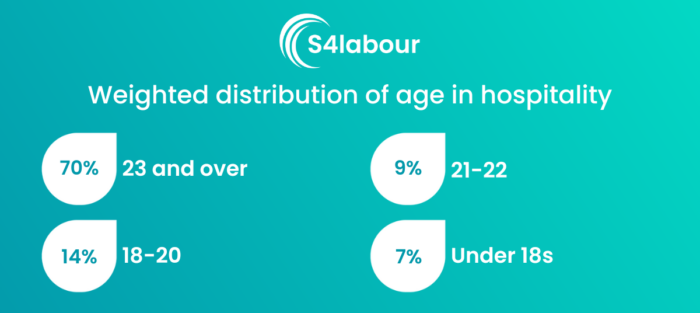
According to data from S4labour, the 9.8% increase to NLW announced yesterday by the Chancellor will mean an increase of 11.5% to costs for operators when considering the weighted impact of age distribution in the industry.   The new wage of £11.44 will apply to employees over 23s, who make up 70% of the hospitality workforce, as well as the 9% of workers who are 21 to 22 years old.   The statistics also reveal that 14% of industry workers fall into the 18 to 20 bracket, with their new wage rising by 14.8% to £8.60. Under 18s, who make up 7% of the industry’s workforce, will see a 21.2% increase in pay.  Assuming all workers are paid at minimum wage, these increases will bring hourly labour costs up 11.5% for operators.   Alastair Scott, CEO of S4labour, commented: “The headline rate at 9.8% was going to be tough enough to manage, without factoring in the high proportion of young people working in our industry. This makes it an even bigger challenge, just when we thought we might be able to get back onto an even keel.” 

Creating a culture of excellence

Opinion piece  by Alastair Scott

It seems to me that one of the best skills to have under your belt in hospitality is the ability to recognise the need for change, and then practice and embed new habits. As an industry, I think we’ve all become accustomed to a lot of change over the last few years. Some good, some bad. But new habits reap new rewards.  

I was at Lisboeta last month and was very impressed when every member of staff said hello and smiled at me when I arrived. I counted 7 in all. An action so simple, but it made a big difference to me. A smile tells you to come in, sit down, and enjoy your time, however long. It makes you stay that bit longer and order one more drink.  

Compare this to staff members who avoid catching your eye when you walk in. In other words, saying: ‘we’re too busy, understaffed and trying to turnover tables as quickly as possible.’ I know what kind of habits I’d rather embed in my business.  

Experts say it takes a month to embed a habit. So, imagine what you could do in a year if you knew what behavioural changes to work on within your team. How much could you increase employee engagement and productivity? 

I want to talk about the difficulty of changing behavioural habits, compared to what I call ‘process habits’. The latter, I think, are much easier to change. Take the big move away from paper rotas to online rotas over the last 20 years: once businesses decided to change how they were writing schedules, it only took the investment in software to change the operational habit. There is of course something to be said about using systems to enforce permanent habit change, but that’s another article.  

Behavioural habits, on the other hand, are much harder to change. There isn’t yet a piece of software that can automate a smile on your staff member’s face. That job falls to management.  

How? We’ve all heard about the many different ways to grow productivity in our teams, but ultimately, it stems from finding the right ways to encourage change in each individual.  

For me, the first step for initiating any change is transparency and consistency in communication. Observe and learn the areas of your business that need improving – is there a tendency amongst staff to stand and talk for 10 minutes around the dishwasher, rather than getting on with a task that could add value? Learn behaviours and tailor training and tasks to encourage change.  

Let staff demonstrate initiative and accountability by encouraging them to take ownership of their roles: what do they think they could do when it comes to dealing with customers or product suggestions? Every day, we need to find the right way to nudge people forward, praising them when they smile and encouraging those who don’t. It will make up for a whole number of small mistakes, costs nothing and of course, these changes in habits and education should drive value and profits. They just need to be thought through in a way that process changes do not. 

The strive for productive and engaged staff is what we are all trying to achieve. So, as we start the journey for more smiles and more hellos, I had better be prepared. 


Being a best-in-class operator

Opinion Piece by Alastair Scott Nowadays, the integration of tech in hospitality has become synonymous with success. I talk to companies who mistakenly think they are best-in-class, simply because they use a software package to support operations. That is so far from the truth. As with all tools, having it is one thing, and using it well is completely another. You should see me versus my finance team on Excel!  This is certainly true when it comes to using technology to help grow profits. In which case, numbers 1,2,3 and 4 on the list are to grow sales. After that, people use tools to help focus on gross profit, and then they give operating costs an inspection. It’s only when all of those areas are exhausted that people look at labour management.   I get it. Labour is hard; labour is people; labour gets a reaction and some resistance. But to be a best-in-class operator, labour can’t be ignored, because it affects both cost and service. With the gap between best-in-class and average accelerating, I think understanding and managing labour better will become the determining factor.   So, how do you measure the effectiveness of your labour management? Labour ratio has been the historic measure of success, but the challenge with labour ratio is that a beer-led operator can run at a ratio of under 20% (coffee and cocktails make it harder), and a fine dining establishment might be heading towards a 40% ratio, so the success of labour management is difficult to measure this way.  In our restaurants, our preferred measure is slack, which is a measure of the excess labour over the agreed service standards of the business.   For many businesses, whether they are wet-led, food-led, high-end, or quick service, 25% slack is good. But even within this, scale matters.   The bigger the business, the lower slack can go. This is because shift patterns can be better designed with more team members, so a slack measure of 15% is not unachievable for large sites.  Why is it important? Service and staff. We have repeatedly evidenced that having too many staff on shift leads to worse service than too few staff. But even so, running shifts with too few staff causes a lot of stress for the team, who will feel no job satisfaction or reward from what could be a really energising session.   That’s why rightsizing your business is important, because it will lead to happier staff and better service.   Over the last decade, our attitude to labour management has been forced to change as labour is more expensive and good people are scarcer. People are also less tolerant of an unhappy, pressurised, or boring workplace.   The tools to become amazing have become increasingly good. We can now measure most of what we need to, and design and determine programs that will improve the quality and profitability of our industry.    Best-in-class has gotten better. Labour is becoming a much bigger differentiating factor between thriving and surviving than it has been historically, so maybe, it might move up the list.