by Alastair Scott | Oct 31, 2025 | Thought Leadership

I have recently, and somewhat belatedly, finished watching Clarkson’s Farm 4, where Jeremy buys his pub. It was an interesting experience for me. Where I have previously found all of his farming shenanigans funny, I was a bit more frustrated at the poor decision-making opening a pub. Perhaps I now understand how the farmers feel. I hope the advice was for TV appeal rather than thinking it might work!
One item really struck me though, which was a little piece Jeremy did on what happens to a village if it loses its pub, and what is left of the village when that happens. His argument was that the village is little more than a dormitory, with no heart and soul, once the pub disappears. It didn’t escape me that while he was making that argument, he was also opening what looked very much like a roadside pub, one that would inevitably draw trade away from the local villages. Sure, the village might still retain some sense of community. It could have a shop (though I’m not entirely convinced that counts, if I’m honest).
But a club, a community centre – somewhere people can actually come together, that really does matter. In our two villages where we operate, one village has a cricket club and a shop. The pub competes with the cricket club as a community hub, and it is great that the two co-exist together.
In the other village, we are the only things left. No shop and no community centre. And the neighbouring two villages have nothing at all. We are their community, and as a result, the three villages now see themselves as a group of villages rather than separate ones.
The village Christmas and Summer parties all happen in the pub, and typically we have a good 100+ attending the events, which have slowly grown over the years. If we believe in community, then we need village pubs to survive. It would be relatively easy to give them support. Exemption from business rates if you are the only pub in the village would make easy sense. A grant if you are the only pub in the village would go further.
But just as important is planning and usage. As we move gently away from alcohol more and more, we are embracing the coffee occasion. Pubs need to become coffee shops so that those who want to meet have a place and a space that works for them.
One of my most depressing drives is across the A66, which joins the A1 to the M6 (you southerners probably won’t have heard of it). I am consistently upset by how busy the farm and coffee shops are, and how quiet the pubs are. The pubs along the strip need to figure out how to make themselves attractive to this market and deliver an offer that works.
How we do this is not easy. When we took on one of our pubs, we built a large extension at the back which not only added loads of covers but joined up a disused barn. We made the mistake of not branding it as a separate coffee venue.
As it happens, since Covid we have repurposed it as a wedding venue and are now building a decent wedding business. We’ve renamed it the Orangery and are now trying to work through how to brand it effectively as both a wedding venue and a coffee shop. Lots of fun.
I once went into a pub in the South that had a small coffee shop next door, run and owned together. I was fascinated watching customers come into the coffee shop who would never have gone into a pub, look around for the best seat, and then wander through to the pub because they preferred the seating. A great lesson in kerb appeal for me.
But of course, if you have a coffee shop and a bar then the danger is that you need two staff to open, and if you are not careful you have immediately lost any profitability you added. So how to work the model, and leave one half or your business unmanned, is a real skill, but an important one to learn.
So, while Jeremy Clarkson might only be seen in the pub drinking a pint, I think the market for coffee is an important one which we need to find a solution for in a fair proportion of our non-city-centre industry. As well, of course, as the government doing what they can for the community as well.
Alastair Scott is CEO of S4labour and owner of Malvern Inns.
by Alastair Scott | Oct 21, 2025 | Thought Leadership

Our restaurant business had a big moment this year – we finally paid off our covid debt. We borrowed £300,000 for our business during covid, which, for a business doing a little under £3m in turnover, is 10%. Not huge, but if you look at it against annual profits, it was a lot larger. In any event, it has taken us nigh on five years to pay it off.
As you might expect, this has been the real challenge for us – and I think for many others in the industry. The length of the debt overhang has been significant, and of course, it isn’t just the debt. When we took on our covid loans, the base interest was 0.1%, life didn’t seem too bad. But as soon as base rates raced up to 5%, life looked very different. So, not only have we paid our £300,000 back, but also another £50,000 in interest.
Unsurprisingly, we haven’t been as profitable in the post-covid years – and honestly, I don’t think we’ve been quite as good either. As a management team, we were recently reflecting on some of the team dynamics and realised that a few individuals wouldn’t have met our pre-covid standards. It’s only now that we feel ready and able to raise our expectations back to where they were before. That said, it’s not easy; we’ve all become a bit too used to a slower pace and a culture where hard work hasn’t always been the norm.
On top of that, we haven’t had the cash to invest in our refurbishment programme, which means some areas we would have upgraded earlier have had to wait. I’m only just now getting around to refurbishing a meeting room that hasn’t been touched in 12 years! It can be frustrating, but this is the reality.
I sometimes wonder whether we should have gone down the company voluntary arrangement route and ditched a load of debt to enable us to start afresh. In truth, I have no idea how common this has been over the last five years, but my suspicion is a lot of people have done it, maybe quietly, and it has helped them get restarted much faster than us. It is one on my list of many regrets.
Nevertheless, the good thing is that, after too long a time, I now feel we are back and able to run the business without any covid overhang – whether in terms of staff or finances. I even took a 16-year-old to work recently because her father was ill and couldn’t drive, and was so impressed by her level of commitment and determination – this really gives me hope.
Service levels are on the rise, we are doing the final bits of refurbishment that have been a little long in the making, and we are feeling positive about what we can achieve. Of course, there are still a few things we need to work on – staff that need to be lifted up to the standards we want, for example. That said, the positives are still there, and it feels like we are moving in the right direction.
There is, of course, the fact that, as an industry, we are still really struggling with a price point that has grown significantly over the years, with the result that volume is, at best, flat. This has meant that our customers will stay home a little more, just come out for a drink or spend a little less when they are here. As operators, we have to find ways to make the value equation work harder for us and deliver experiences that our guests want to come back for. The outcome is that we need, as always, to be holding ourselves to account – constantly questioning how we can improve and where we can do better.
We want to keep raising standards of amenity, service and food quality to make the value equation worth it for our customers. Perhaps now, the business can pay me some of the loans I have put in!
Alastair Scott is chief executive of S4labour and owner of Malvern Inns.
by Alastair Scott | Oct 3, 2025 | Thought Leadership
 A few years ago, we introduced our Goldilocks programme, “writing the perfect rota, that’s not too hot and not too cold”. This always gets a giggle (or a little groan), but in essence, it’s a name that sticks, and our customers love it.
The theory goes that systems can change some habits, but by no means all of them. The rest of the change needs to be done by people, to people. For some systems, such as a property management system, the implementation will automatically change more of the business behaviours (but it still won’t stop you rejecting the booking if you don’t want to take it). But with people management, old fashioned persuasion is the key.
If your kitchen team like doing prep in the morning, or if your front of house team always do admin on a Monday, then the chances are that putting in a system won’t change these habits. The real change comes around when experts persuade other people to think differently and convince them that there is a better way. Not easy, but doable.
Since our first project, we have completed hundreds of Goldilocks visits and have been constantly learning how to refine the art of getting people to better themselves. Too often, the solution is easy but the wrong habit is embedded, and persuading people to change what they have always done is hard. It takes 66 days to change a habit, so maintaining the new behaviour needs constant reinforcement too if it is not going to wither on the vine.
So, what are the main elements of a Goldilocks visit? Of course, it all starts with shift management, challenging and adjusting how a shift is run to optimise the team’s efficiency. We all know too many staff leads to worse service, as I witnessed recently – I walked into a major casual dining group, was confronted with the “please wait to be seated” sign and waited five minutes (probably three in reality) while two staff members finished their conversation before attending to us.
What we define as slack tasks and when we do them is another vital element of the process. Moving rostered fixed tasks to slack tasks to be done in down time is, of course, a massive cost saving, but you won’t achieve any of it if you don’t have the mindset. This is a really hard change programme.
Considering a site’s nuances and giving the managers the opportunity to really get their point across always gets their buy in. They can talk about their challenges, but with a bit of guidance and a fresh set of operator’s eyes, they always start to think about the way they do things and whether there’s a better behaviour that will drive sales, save them some cash and ultimately improve the guest experience.
The changes we have seen are better than even the optimist Alastair might have wished for. In bigger sites, savings of £40,000 a year are the norm. But the real surprise to me is in smaller sites. The old saying with labour management is that you can’t save much in smaller operations. Our Goldilocks programme begs to differ, with savings of circa £20,000 at the “lower turnover” end of the scale. This strangely means that the proportion of labour saved goes up as the size of the site goes down. This is not what most people, me included, expected – so why is that?
The chances are the organisation managing these smaller sites maybe doesn’t have the internal skill set to optimise or hasn’t given it the focus because it doesn’t believe it can get any better – but it can. I always love the counter-intuitive solution where you must re-think your starting position, and this is certainly one of them.
The interesting bit for me is why people employ us versus doing it themselves – I am always one for doing things myself and tend to be a bit reluctant to enlist outside help. I blame cost, but in reality, it is because I hate admitting I am not good enough at everything and I simply do not have the time!
The reality is spending a day just “doing rotas” is hard to schedule and hard to stick to when you have all your other business pressures, despite the fact this could (or should) sit at the top of the priority pile. The real differentiator is the stories that people can tell to convince people they aren’t alone; there are many who have been through the same journey, and they are still great operators who can be even better. I think the psychology of the programme is the most important element.
Helping our large customers make far more money is satisfying, but one of the most gratifying elements of our programme has been, quite literally, saving single site operators. When someone is going to go bust if they don’t do anything about labour cost, they certainly have the motivation to succeed. It is such a great feeling when we can finally help them make their business work. These are pubs, and communities often rescued. And that’s it – creating a rota that is not too hot, and not too cold, does make a difference.
Alastair Scott is chief executive of S4labour and owner of Malvern Inns
by Alastair Scott | Aug 27, 2025 | Thought Leadership
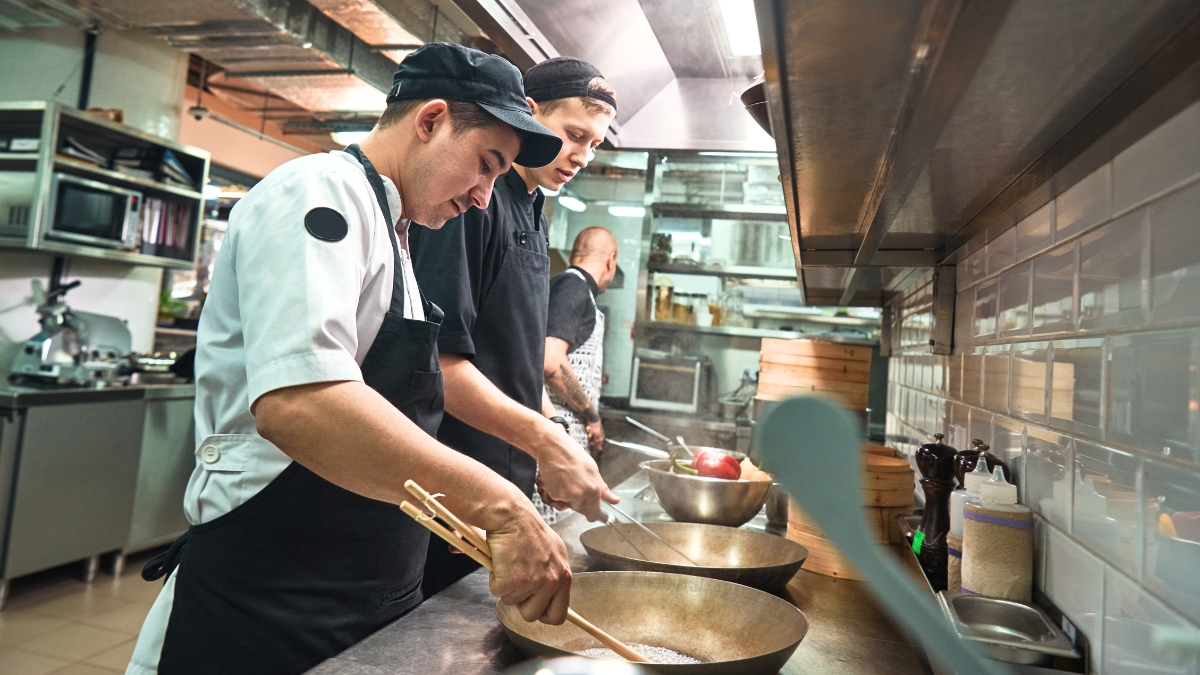
Central kitchens have, I think, become a dark (no pun intended) secret of our industry. We somehow believe that it reduces our credibility if we admit that we use a central kitchen to produce some of the items for our menu. But really, there are several great reasons to have a central kitchen – or even use one of your kitchens, if you have multiple sites.
The first reason is quality. If one person knows how to make a difficult dish really well, then why not get them to make it all the time? If someone is an ace at making brownies, they should make them for everyone, because the guest will notice. And the same goes for fish pie mix, or for the marinade for ribs, and maybe even the cooking process too. Even now, this makes my mouth water – I love ribs. But of course, there is a downside. If the whole fish pie is made centrally, then perhaps the fish pie will turn mushier and the fish will fall apart if it is cooked twice. I think the best fish pie has raw fish added to the mix and then cooked fresh.
So, we have to be really careful about what is made or cooked centrally, and far more importantly, what isn’t, based on the value equation for our business. That is the risk; the perception is that the central kitchen is taken too far, and rather than quality being enhanced, it is reduced. After all, time can be either an enhancer of a dish or a destroyer, as we all know from eating our stew or bolognese on day two.
Our real challenge is how to communicate our kitchen processes and practices well enough. And so, in truth, if we haven’t communicated at all, what’s the point of them? I think we could do a better job and take this on in a positive way, by naming the chef and showing him at work. Social media could make a real difference here, and I always think it is better to find a positive way to deal with the PR, rather than letting a cancerous negativity pervade. There is a chain of quite high-end restaurants in Harrogate that has lost the battle on central kitchens. All rumour, but there is nothing to counteract it.
The second reason is consistency. If a dish is hard to make, then why not do it in one place? For those chains that require consistency for the brand values, then it is essential. I couldn’t imagine McDonald’s making their burgers on site or cutting their chips. For some, of course, the requirement for complete consistency is not an issue. It is expected that each chef might want to do things slightly differently. But even then, if you like it one way, you will probably be disappointed. I prefer my rib falling off the bone!
The third is people cost. There is a significant saving in cost if you can get this right. You can buy expensive kit and use it far more often if you are doing it in one place. We don’t really want highly paid chefs chopping onions the old-fashioned way if we can help it. You can make batches of dishes that take little more time to do in large quantities than in small ones and so gain big economies of scale. And naturally, labour costs may be lower, as kitchen staff may not require traditional chef training – they’re primarily operating machines.
The fourth reason is premises cost. When rents are sky-high in city centres, why would you want to use that space for kitchen prep if it can be done in a cheaper location elsewhere? It is best to have more covers and drive greater sales. This could add, say, another ten covers to a 100-cover restaurant, which is a significant sales growth opportunity.
For the smaller brands, there are versions of this that can be utilised. Items could be prepared in one kitchen for the group, for any of the above reasons. You don’t have to have another premises. We need to do this anyway for our wedding and outside catering business, so we are learning how to do it.
I think we need to get on the front foot in our industry about what we do where. Any hint or rumour of a central kitchen will draw us closer to the M&S comparison. And if we drive the positives, both cost and revenue, then we can, and will, make our industry a better one.
Alastair Scott is the owner of Malvern Inns and chief executive of S4labour
by Alastair Scott | Jul 11, 2025 | Thought Leadership

We have just concluded an investigation by HM Revenue & Customs (HMRC) into minimum wage compliance at our small group of restaurants. The investigation has taken nine months, with HMRC conducting a very thorough and intense review of our whole business. HMRC looked at payroll records and rota records to check that what was on the rota was actually then paid.
Officials interviewed staff to check that the times on the rota were the actual times worked, and that we weren’t removing worked hours. HMRC fully investigated all of the areas where it hoped it might find something wrong. Did we uplift to new rates on the right date? Did we uplift rates when people moved age brackets? Did staff provide their own workwear that required us to pay above the minimum wage? Did we correctly pay people when they moved from hourly to salaried?
It felt a bit like being followed by a police car; you think you are doing everything right, but then start to doubt yourselves the longer the police car follows you, thinking through everything you might be doing wrong and conducting a mental checklist. Over the course of the investigation, we started to doubt ourselves and thought we might have overlooked something. Had we paid people correctly when they transferred between sites? Were our contracts correct about the place of work? Had the S4 system worked correctly in all cases, or had we incorrectly put someone’s birthday into the system and underpaid them? All those things kept us slightly worried.
I understand that HMRC investigations are often triggered by reports from former employees. Of course, these reports may stem from genuine concerns or misunderstandings. While we can’t be certain of the reason behind our investigation, we approached the process with full transparency and, regardless of the origin, it served as a valuable opportunity to really test our compliance system.
I was, of course, very relieved to finally get a clean bill of health after its latest rounds of checks. Given the time it took, I had half expected HMRC to never close the investigation and leave us nervously hanging in the air forever. It was clearly very disappointed. I think from the way the officials behaved, they normally find an error somewhere, and they know where to look. Without a system, I would be sure that we would have missed a birthday somewhere, which I think would be the most likely error.
But the way officials looked at any change from hourly to salaried suggests that this is also a common place for operators to fall. The time they spent checking that the rota’d hours worked were the actual hours worked by the employee also suggests that is a difficult area for our industry.
The fine structure for any failure is a maximum of £20,000 per worker, and any errors investigated need to be paid back over the six years HMRC can go back in its investigation. I assume that when it finds one fault, it will then look at whether that fault is repeated across the whole employee base. The minimum fine is £100 per employee, but even if you have, say, ten employees and a staff turnover rate of 100%, then over six years, you may well have had 60 staff, so you are already at £6,000. Scary stuff.
So, what are the actions we can all take? Never having an aggrieved worker seems impossible. We will all typically take on someone who doesn’t work out and is unhappy about being dismissed, so really it is about having excellent process and procedures to ensure that the legislation is complied with.
I am interested in how HMRC might determine any failures in hours worked versus hours paid, but luckily, we won’t get to find out. As the minimum wage increases, a higher proportion of staff will be paid the minimum wage, and as such, our risks and potential fines go up. I hope HMRC won’t be back to visit us soon, but hopefully this may serve as a reminder that we all need to make sure we have all the right checks in place.
Alastair Scott is chief executive of S4labour and owner of Malvern Inns