Autumn 2023: What do the Chancellor’s announcements mean for hospitality?  

Autumn Statement 2023

Chancellor Jeremy Hunt has today released his Autumn Statement, bringing forward measures on NLW, alcohol duty, business rates and NI that will have an impact on the industry and its workers.

The National Living Wage will see an increase of 9.8% to £11.44 an hour, averaging an additional £1800 a year per full-time employee. This new rate now also applies to employees who are 21 and 22 years old – previously, it was only for workers over the age of 23. Though beneficial for the staff, this rise means a typical pub will see labour ratio hike around 3 percentage points. In addition to this increase, employee NI will drop from 12% to 10%, though employer contributions to NI have not been cut.

The extension of business rates relief is good news, and will help around 230,000 smaller retail, hospitality and leisure businesses in 2024-25. It also seems the Chancellor has listened to calls for alcohol duty to be frozen, meaning there is one less cost for operators to worry about until August next year. 

Chief Growth Officer at S4labour, Richard Hartley, commented: “We have spoken to operators who are currently struggling with labour ratios of 34%+, so this further increase in spend will be challenging, and we anticipate this will put pressure on consumer prices. As wages continue to rise, managing the cost is going to be the single-most important factor in the future success of our industry.” 

Creating a culture of excellence

Opinion piece  by Alastair Scott

It seems to me that one of the best skills to have under your belt in hospitality is the ability to recognise the need for change, and then practice and embed new habits. As an industry, I think we’ve all become accustomed to a lot of change over the last few years. Some good, some bad. But new habits reap new rewards.  

I was at Lisboeta last month and was very impressed when every member of staff said hello and smiled at me when I arrived. I counted 7 in all. An action so simple, but it made a big difference to me. A smile tells you to come in, sit down, and enjoy your time, however long. It makes you stay that bit longer and order one more drink.  

Compare this to staff members who avoid catching your eye when you walk in. In other words, saying: ‘we’re too busy, understaffed and trying to turnover tables as quickly as possible.’ I know what kind of habits I’d rather embed in my business.  

Experts say it takes a month to embed a habit. So, imagine what you could do in a year if you knew what behavioural changes to work on within your team. How much could you increase employee engagement and productivity? 

I want to talk about the difficulty of changing behavioural habits, compared to what I call ‘process habits’. The latter, I think, are much easier to change. Take the big move away from paper rotas to online rotas over the last 20 years: once businesses decided to change how they were writing schedules, it only took the investment in software to change the operational habit. There is of course something to be said about using systems to enforce permanent habit change, but that’s another article.  

Behavioural habits, on the other hand, are much harder to change. There isn’t yet a piece of software that can automate a smile on your staff member’s face. That job falls to management.  

How? We’ve all heard about the many different ways to grow productivity in our teams, but ultimately, it stems from finding the right ways to encourage change in each individual.  

For me, the first step for initiating any change is transparency and consistency in communication. Observe and learn the areas of your business that need improving – is there a tendency amongst staff to stand and talk for 10 minutes around the dishwasher, rather than getting on with a task that could add value? Learn behaviours and tailor training and tasks to encourage change.  

Let staff demonstrate initiative and accountability by encouraging them to take ownership of their roles: what do they think they could do when it comes to dealing with customers or product suggestions? Every day, we need to find the right way to nudge people forward, praising them when they smile and encouraging those who don’t. It will make up for a whole number of small mistakes, costs nothing and of course, these changes in habits and education should drive value and profits. They just need to be thought through in a way that process changes do not. 

The strive for productive and engaged staff is what we are all trying to achieve. So, as we start the journey for more smiles and more hellos, I had better be prepared. 

 

Get the best from holiday management, says S4labour  

Leading rota, people and payroll tool provider S4labour, has shared some tips to help independent convenience and forecourt operators best manage their labour throughout the busy holiday season.  

It becomes increasingly difficult to balance the needs of your shoppers and your team as well as thinking about profits and compliance when experiencing these different patterns of trade. So, for independent retailers, it is well worth investing in tools that can help them do the work efficiently, cost-effectively and without stress. 

Some of the challenges facing retailers will include requests for time off or additional hours, as well as scheduling according to big events that are likely to see people get together, like summer sporting events, barbecues and local fetes. 

Garry Craft, S4labour, Managing Director Convenience Stores, says: “Walking the line of having enough staff whilst not overspending on a labour budget can be difficult. 

The first step for successful labour management is to use tools and insights that give visibility of historic sales data and labour spending. Looking at week-by-week and day-by-day labour spending will give more insight into how retailers should be planning rotas, compared to just looking at quarterly totals.” 

The rota, people and payroll tool provider also state that having this visibility of labour spend, particularly before it is spent, will avoid unexpected costs for retailers. 

Craft continues: “Circulating rotas earlier will help employees visualise shift plans easily, and as a result, any problems are much easier to spot. Synchronising rotas with the holiday calendar allows managers to see staff availability on key dates. 

Maintaining effective communication with staff regarding rotas is an important follow-up step. This can be made simple through an app or system that serves as one point of truth. Managers can organise shift patterns and staff can volunteer for open opportunities, which ensures demand is always met and everyone is on the same page. 

We appreciate that location will affect holiday planning, as those in tourist locations will be up over the summer, and different stores will trade in different ways. S4labour recommends having tools in place that work around your individual business needs.   

There are tools out there that make it easy for owners to manage holidays, create balanced schedules and check rotas against time and attendance clock-in and out times.” 

The key to cost management: cutting slack for improved service and staff satisfaction 

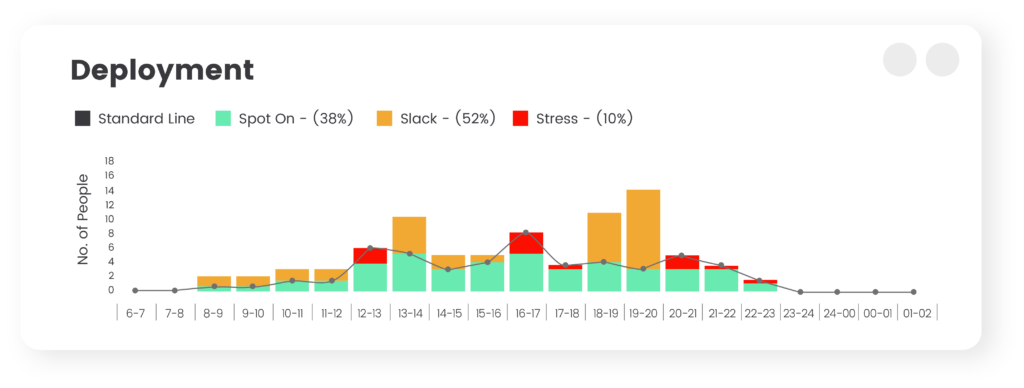
In the world of hospitality, managing costs effectively is an ongoing challenge. Traditionally, labour ratio has been a key metric for measuring success, but we think a more nuanced approach is needed to ensure both efficiency and quality. At S4labour, we use the metric of ‘slack hours’ to measure the effectiveness of cost management.  

Understanding slack: 

Slack refers to labour hours used on the rota that are above what is needed to deliver the agreed service levels. It’s the extra time that can be utilised for tasks like polishing cutlery and cleaning menus, without putting undue pressure on the staff. Finding the right balance of slack is crucial – aiming for around 25% slack is considered optimal for many businesses, but there are variations depending to scale and style of site. 

The pitfalls of too much slack: 

Overstaffing, with high levels of slack for a prolonged period, is not only a poor use of labour budget, but it also leads to a decline in team energy and concentration levels which ultimately affects service quality. Striking the right balance requires consideration of the specific needs and scale of your business.  

The importance of rightsizing:  

The size of your business plays a role in determining the ideal slack percentage. Larger sites can operate with lower slack percentages (around 15%), as more team members allow for better-designed shift patterns. This nuanced approach ensures that the right amount of slack contributes to a well-functioning operation without compromising on service. 

Adjusting labour costs not only optimises efficiency, but it will also lead to happier staff and improved service quality. By managing slack hours, you create an environment where employees can excel without the stress of excessive workload. 

Finding the right balance between labour costs and service quality is ultimately the key to better cost management. When measured and used effectively, slack becomes a powerful tool for improved service and staff satisfaction. Whether you run one bar, or manage multiple restaurants, success starts with optimising your labour costs.  

Get in touch with S4labour to explore how we can help you to cut the slack and run a more efficient, happier and service-oriented business.  


Hospitality sales see first decline since March

The latest figures for October reveal the industry experienced a 1.4% decrease in sales overall, compared to the same period last year, according to data from S4labour.  

This decline was driven by sites outside of London, with sales dropping by 2.5%, whilst London saw a moderate increase of 3%. October also marks the first time since March that overall sales have been down.  

S4labour’s Chief Growth Officer, Richard Hartley, commented: “As we begin the run up to Christmas, this downward trend is not what we would have hoped for, especially considering last month’s staggering 9.6% growth. Only two out of the ten months so far this year have seen a decline, so we are optimistic that as celebrations begin over November and December, we will start to see some positive figures again.”  

The effects of ‘No-shows’

The latest figures from Zonal, in partnership with hospitality data and insights firm CGA by NIQ, confirm that 2023’s no-show rate has returned to post-lockdown levels. Doubling from 6% in September 2022 to 12%, these statistics highlight the need to keep this important issue top of mind.

As COVID-19 continues to move further into the rear-view mirror, data shows that it is easy for consumers to forget the struggles hospitality has faced. Despite rising energy costs, staffing and supply chain issues, and the cost-of-living crisis, research from Zonal states that 1 in 7 customers book and then fail to show up without informing the venue. The implications of these ‘no-shows’ are not just financial, but contribute to negative customer service, over-staffing, and wastage.

One of the biggest costs to a hospitality business is labour. People are expensive and having ‘no-shows’ means that more team members are on shift than is necessary.

If we delve deeper into this issue, it is much more than an additional cost to the business. With a reduced amount of work, team members feel unproductive and unsatisfied. We have repeatedly evidenced that having too many staff on shift leads to worse service than too few staff. So, what can be done?

1. Communicate with your team:

  • Driving the engagement and motivation of staff with effective communication makes a big difference to how well your labour is spent. Using a team app as a point of truth for shift allocations and tasks will increase productivity for every shift.

2. Ensure you are paying for the actual hours worked:

  • Need to send a team member home earlier than expected? This shouldn’t be a problem, as long as you have a time and attendance system. This means the team member can clock out when they leave meaning you’re not overpaying for a shift.

3. Accurately report your sales and labour performance:

  • A reporting tool from previous days till data, previous weeks and against last year for a like-for-like view can help you prepare for particularly busy periods, such as Christmas.

Zonal’s report as well as S4labour’s top tips can help significantly reduce the number of ‘No-shows’ and the impact it has on operators. However, it is essential that UK consumers are educated on the full impact that ‘No-shows’ are having, especially with ‘no-shows’ costing the hospitality industry £17.59bn a year. It is important now more than ever to #showupforhospitality!

Discover Zonal’s ultimate guide to eliminating ‘No-shows’ here: Show Up For Hospitality – Stop No-shows (zonal.co.uk)