by Abby Henson | Sep 15, 2025 | Sales Figures

The latest figures from S4labour show a 2.9% increase in hospitality sales in August 2025 compared to the same period last year, with London once again driving the uplift. The capital saw a standout 10.5% rise in like-for-like sales, while non-London regions recorded a modest increase of 0.9%.
Dry-led venues across the UK were up 2.4%, with London dry-led sites outperforming at 9.2% growth. Outside the capital, dry-led venues saw a smaller uplift of 1.1%. Wet-led sites experienced a 4.2% increase overall, with London wet-led venues surging by 12.1%, compared to a marginal 0.4% rise in non-London areas.
Richard Hartley, Chief Growth Officer at S4labour, commented:
“London’s strong performance this August was likely boosted by the warmer, more settled weather compared to last year, which encouraged greater footfall across both wet-led and dry-led venues. However, ongoing cost pressures and more cautious consumer spending continue to temper growth outside the capital.”
by Alastair Scott | Aug 27, 2025 | Thought Leadership
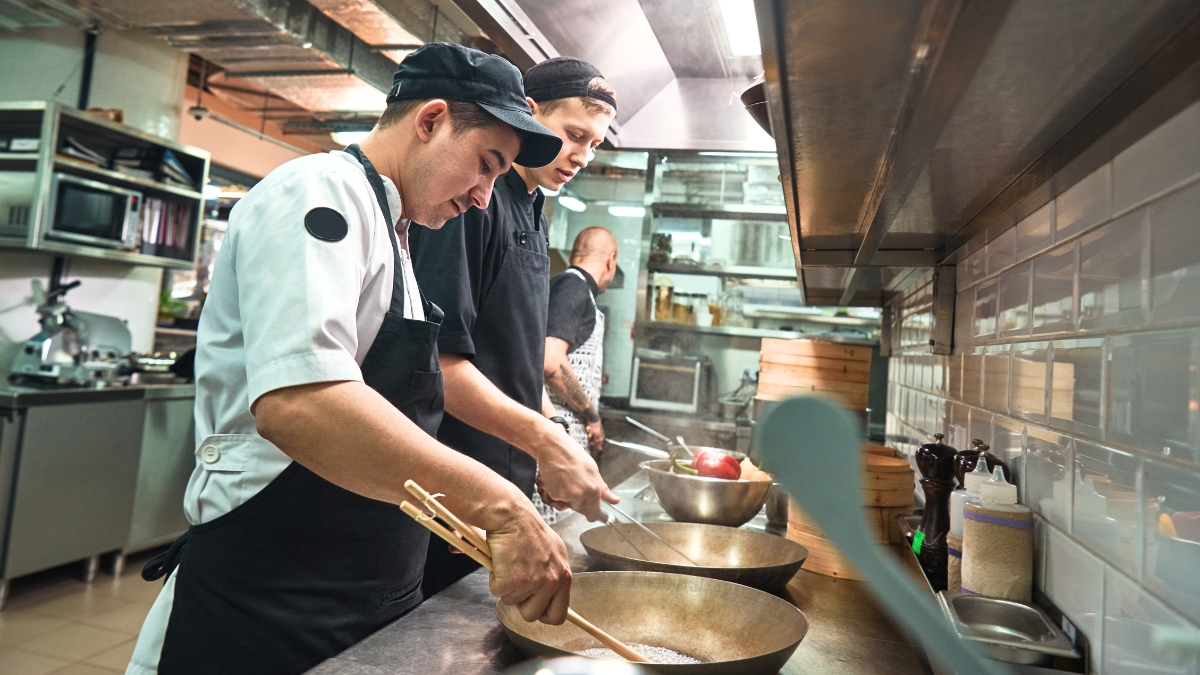
Central kitchens have, I think, become a dark (no pun intended) secret of our industry. We somehow believe that it reduces our credibility if we admit that we use a central kitchen to produce some of the items for our menu. But really, there are several great reasons to have a central kitchen – or even use one of your kitchens, if you have multiple sites.
The first reason is quality. If one person knows how to make a difficult dish really well, then why not get them to make it all the time? If someone is an ace at making brownies, they should make them for everyone, because the guest will notice. And the same goes for fish pie mix, or for the marinade for ribs, and maybe even the cooking process too. Even now, this makes my mouth water – I love ribs. But of course, there is a downside. If the whole fish pie is made centrally, then perhaps the fish pie will turn mushier and the fish will fall apart if it is cooked twice. I think the best fish pie has raw fish added to the mix and then cooked fresh.
So, we have to be really careful about what is made or cooked centrally, and far more importantly, what isn’t, based on the value equation for our business. That is the risk; the perception is that the central kitchen is taken too far, and rather than quality being enhanced, it is reduced. After all, time can be either an enhancer of a dish or a destroyer, as we all know from eating our stew or bolognese on day two.
Our real challenge is how to communicate our kitchen processes and practices well enough. And so, in truth, if we haven’t communicated at all, what’s the point of them? I think we could do a better job and take this on in a positive way, by naming the chef and showing him at work. Social media could make a real difference here, and I always think it is better to find a positive way to deal with the PR, rather than letting a cancerous negativity pervade. There is a chain of quite high-end restaurants in Harrogate that has lost the battle on central kitchens. All rumour, but there is nothing to counteract it.
The second reason is consistency. If a dish is hard to make, then why not do it in one place? For those chains that require consistency for the brand values, then it is essential. I couldn’t imagine McDonald’s making their burgers on site or cutting their chips. For some, of course, the requirement for complete consistency is not an issue. It is expected that each chef might want to do things slightly differently. But even then, if you like it one way, you will probably be disappointed. I prefer my rib falling off the bone!
The third is people cost. There is a significant saving in cost if you can get this right. You can buy expensive kit and use it far more often if you are doing it in one place. We don’t really want highly paid chefs chopping onions the old-fashioned way if we can help it. You can make batches of dishes that take little more time to do in large quantities than in small ones and so gain big economies of scale. And naturally, labour costs may be lower, as kitchen staff may not require traditional chef training – they’re primarily operating machines.
The fourth reason is premises cost. When rents are sky-high in city centres, why would you want to use that space for kitchen prep if it can be done in a cheaper location elsewhere? It is best to have more covers and drive greater sales. This could add, say, another ten covers to a 100-cover restaurant, which is a significant sales growth opportunity.
For the smaller brands, there are versions of this that can be utilised. Items could be prepared in one kitchen for the group, for any of the above reasons. You don’t have to have another premises. We need to do this anyway for our wedding and outside catering business, so we are learning how to do it.
I think we need to get on the front foot in our industry about what we do where. Any hint or rumour of a central kitchen will draw us closer to the M&S comparison. And if we drive the positives, both cost and revenue, then we can, and will, make our industry a better one.
Alastair Scott is the owner of Malvern Inns and chief executive of S4labour
by Abby Henson | Aug 26, 2025 | Sales Figures
 The latest data from S4labour reveals hospitality sales across the UK rose by 2.2% in July 2025 compared to the same period last year, with London significantly outperforming the rest of the country. The capital saw a 9.8% increase in like-for-like sales, while non-London regions experienced a slight decline of 0.2%.
Food-led venues in London were up 9.5%, compared to just 0.5% growth outside the capital. Wet-led sites also saw a strong uplift in London, rising 10.2%, while non-London wet-led venues fell by 2.1%.
Richard Hartley, Chief Growth Officer at S4labour, commented: “London’s hospitality boom this July could be due to a number of factors, including above average temperatures and return to office culture, with operators well-positioned to capitalise on increased demand. Inflationary pressures continue to pose challenges for all operators across the country, likely dampening performance outside of London in particular.”
by Abby Henson | Aug 6, 2025 | Blogs

Spending big on your labour, but not seeing your sales increase?
Your labour budget is decided, and you aren’t cutting corners when it comes to spending it; you’re ensuring every shift is fully staffed and your team are working the hours – so why aren’t you taking more money?
Understandably, you may be quite frustrated with the amount of time and productivity you are getting out of your current rotas. You may even find that a lot of your team are in at points in the business where they just aren’t needed for the amount of guests.
You’ve likely had upwards of hundreds of thousands of pounds worth of cost pressures since April, and the easiest thing to do would be to say: “this amount of labour is not essential” and cut, cut, cut. But as a business, you cannot afford to compromise on how service feels on the floor and to your guests.
So, you’ve got to strike the right balance. The good news is, you don’t need to spend even more on your labour to make more money – what you need is control over where you are spending it, and an understanding of why.
How often have you walked into a venue and the service doesn’t match what they are trying to achieve? Hours shouldn’t have to be cut to fix this, but what needs to happen is a deep dive into the business to see when is most productive and when is not. It’s all about highlighting the finer aspects of rota-writing and how you plan your week.
S4labour’s tools are built to give you that control, so you have a confident platform to start growing sales from. Take a look at how we helped Grosvenor start expanding out on bigger sales.
“With some incremental changes to each business, it meant that, as a whole, Grosvenor became more productive, more efficient and certainly on site it gave a lot of control and knowledge to the fingertips of our general managers.”
Sam King, Business Director at Grosvenor Pubs and Inns.
Anybody would be a bit apprehensive about bringing in a new system, but S4labour will help your team, from head chefs to general managers, to start looking at the business in a sales-driven way, rather than a cost cutting way.
“So we put S4 in and you can actually see with the percentage of sales turnover that everything we made in that year was attributed to that control.”
Sam Hagger, Founder and Managing Director at The Beautiful Pubs Collective.
Join the operators already growing sales with S4labour. Book a demo to see what’s possible.
by Abby Henson | Jul 22, 2025 | Blogs

Only 33% of Hospitality Operators Have a Workforce Management System That Works
A recent industry survey from S4labour reveals that only 1 in 3 operators report having a workforce management system that truly works for their business, while 24% respondents selected that they do not know what a workforce management system is at all.
The same survey also found that 67% of operators reported that their staff always upsell or suggest additional items to guests, while 1 in 3 operators do not set shift incentives or targets for their teams.
Furthermore, 77% of operators agree that the biggest driver for increasing sales is improving habits through training.
Mark Jensen, Chief Commercial Officer at S4labour, commented: “Operators know that better habits lead to better performance. Without a reliable system in place, those habits are hard to track and reinforce, so this data presents a major opportunity for tech providers and operators.”
by Abby Henson | Jul 11, 2025 | Sales Figures

In June, overall sales were down 2.6% compared to the same period last year, the latest data from S4labour has revealed.
There was a significant 8.7% drop in sales for wet-led sites, while food-led venues edged up by 0.2% year-on-year.
London saw a 6% increase overall, however venues outside of the capital reported a 5.3% decline.
Mark Jensen, Chief Commercial Officer at S4labour, commented: “Despite record-breaking warmth in June, sales in drink-led venues were down significantly, pointing to deeper behavioural and economic shifts. For July and August, operators will be watching to see if this trend continues or rebounds, while still navigating significant cost pressures.”